Saturday, February 25, 2006

When Forgiveness Incites Rage


Ah, the good ol’ days! Travel used to be so simple then.

When I was a kid, part of the excitement of any trip south of Chicago was the picnic in the car. There were always sandwiches, fried chicken and cookies. If we were lucky, there was cake. If someone had to tinkle, we merely pulled onto a shoulder and ran down an embankment, out of view.

We knew where we could stop and where we couldn’t; we knew what we could say and what we couldn’t. Choose the wrong stop, say the wrong word, have the wrong expression on your face, and the males in the car would most likely inspire an even larger picnic. Folks would come from miles around, toting their blankets and young ones to see humans hanged from trees. And this was wholesome family entertainment.

How soon we forget those perilous times. Here I set off on the road to Forgiveness…the Final Frontier--alone, with no rations, and not the slightest bit of apprehension. What, me worry? Times have changed. I fully expected that I would be able to stop anywhere and that I’d be accepted, if not welcomed.

Earth to Pat: Wake up and smell the coffee. Forgiveness isn't always embraced. It doesn’t always heal; in fact, sometimes it incites full-blown rage. I found out the hard way.

I posted my Get out of a Jam with the “F” Word essay on Gather.com last week, because the community over there actively shouts back, and we have great dialogue even if we don't always agree. The "F" Word essay was selected by the Gather editors for the blog site's home page, which heightened its visibility.

That was good news--and bad news. One reader not only objected to the topic; he characterized it as "cult like, cypto-religious psychobable" that "bleeds over into the islamic cartoon mentality".

I'm not sure what shift this guy works on the blog police force, but I'll try not to post again when he's on duty, lest I inspire another one of those ill-fated picnics. He was particularly outraged that I had the temerity to take it upon myself to do something divine.

“Who and what are YOU, to forgive anything?” he screeched.

Alrighty now. This brother obviously was not having a good Friday, and I apparently hadn’t made it any better. Maybe his paycheck was short, I don't know. But despite all his ranting, this dude had as much chance of goading me into a wrath-filled tirade as I had of convincing him to give his carcinogenic rage a rest.

But he did get my attention, for a reason that was both peculiar and eerie: It was the second time in less than 24 hours that I’d heard these venomous words. The first time, I was watching a public TV segment about the premiere of the documentary, “Forgiving Dr. Mengele”.

The 80-minute doc profiles a Terre Haute, Indiana woman Eva Mozes Kor, who survived Nazi doctor Josef Mengele’s diabolical medical experiments on 1,500 sets of Jewish twin children. Fewer than 200 survived.

During a public ceremony at Auschwitz in 1995, Eva decided to free herself from those painful memories. As she later told a Catholic Herald reporter, "I realized that I had the power to forgive, that no one could give me the power and no one could take it away. And for a little victim, who was a victim for almost 50 years, to realize that I have the power made me feel very good."

Eva loved that feeling, so she openly forgave her torturers and the other Nazis whose intolerance of difference led to the murders of her parents, siblings, millions of other Jews, and almost as many Jehovah’s Witnesses and homosexuals.

How dare she.

“Who are YOU to forgive anyone?” another survivor angrily screamed at her, declaring that forgiving the Nazis was an insult to their victims.

Why does forgiveness attract full-blown rage? Who knows? Ask Gandhi. Ask Martin. Ask those who love their anger and pain so much, they’ll resentfully attack others who choose inner peace. Some attacks are more vicious than others, which truly tests one's resolve to forgive, as Eva discovered when arsonists destroyed her small Holocaust museum.

To err is human, but why do we think that only God can and should forgive? Why is it that when we resolve to act less human and more divine, there are always those who will dramatically demonstrate the difference between the two?

What happens when we decide not to let anger fester inside of us? According to Eva, "I felt immediately a burden of pain was lifted from my shoulders, that I was no longer a prisoner of my tragic past, that I was no longer a victim."

This, from a woman who was snatched from her parents and older sisters, who stepped over the skeletal corpses of other captive children in the concentration camp latrine, whose young body was poked and probed and injected with germs that were expected to kill her. And we're still ticked off with someone...about what?


If you ask Eva, she'll tell you in a minute, "Forgive your worst enemy. It will heal your soul. It will set you free!"

As for me, I'm kicking it into passing gear--and putting my bail bond card on the dashboard, in case I run into another hard-nosed blog cop between here and the Final Frontier.

Saturday, February 18, 2006

Did you leave a message?


While being interviewed this week for Dana Roc’s “Inspiring People” column, she asked me, “One hundred years from now, what do you want to be remembered for?”

It reminded me of this scenario Stephen Covey painted years ago in his inspiring bestseller, The 7 Habits of Highly Effective People: You’re at the funeral of a loved one, approaching the casket. When you look inside, you come face to face with…yourself.

Stunned, you sit and wait for the services to begin, reading the program. There will be four speakers. One is a family member, another is a friend; the third is a business associate, and the fourth is someone with whom you’ve performed charitable or church work.

What will they say? The question is both provocative and eerie for me. First, it’s disconcerting to imagine myself at my own funeral, primarily because I’ve forbidden my family from hosting one of these gatherings on my behalf. If they feel compelled do something, absolutely no lifeless bodies are allowed on the premises. Jiminy Christmas! They’re such a downer.

Despite my aversion to these momentous events, I must admit that Covey’s illustrative example of highly effective people’s #2 habit, “beginning with the end in mind” made me think. I’d resolved that I’d play hooky from the whole affair, but I’d never thought about what would be said about me after I leave Pat’s body.

Think about it, Covey urged: “What would you like each of these speakers to say about you and your life? What kind of husband, wife, father or mother would you like their words to reflect? What kind of son or daughter or cousin? What kind of friend? What kind of working associate?

“What character would you like them to have seen in you? What contributions, what achievements would you want them to remember? Look carefully at the people around you. What difference would you have liked to have made in their lives?”

Pow! Even now, 15 years after I first read Covey’s words, they still pack a punch. I recall thinking back then what a terrific opportunity he'd given me: the chance to re-write my script, "with the end in mind." Sometimes, we get so caught up in our daily dramas that we lose sight of that unavoidable end, and we forfeit the opportunity to fine-tune the speeches the other actors will read in that final scene.

I find that it’s helpful to take inventory, periodically. Don't you?

When’s the last time you asked yourself, "How am I impacting others? What difference am I making? Are my family, friends and business associates observing that I’m growing in character, understanding, and compassion, or that I’m simply growing older?"

What will they say? What lines will you have written for them?

We’re all messengers. What message are we leaving for those who are close to us and those we encounter, even casually, enroute to our end?

We’re all here for a purpose. What’s yours? If you don’t know it, when do you plan to find out? Are you content to wander aimlessly in the desert until they shovel sand in your face, or will you leave a message that neither time nor windstorm can erase?

Who are you, really? Are you today the person you want to be? Do you know who you want to be?

What will they say when the curtain falls? What will be their indelible memories about you? How will you direct that final scene?

Time's almost up. The interview is drawing to a close. There’s just one more question:

“So Pat, 100 years from now, what do you want to be remembered for?” Dana asked earnestly.

I thought for a few seconds. Then I knew with certainty. “I want to be remembered for delivering Truth…joyfully.”

Surprised, she wondered, “Anything else?”

Now that she mentioned it, there was one more thing.

“Loving unconditionally.”

(To read the entire interview, click here.)


Saturday, February 11, 2006

A Hard Head Still Makes a Soft Behind

My mother isn’t the only one who used to say that, is she? Nah. We’ve all heard it, at some point. Sometimes we believed it, and brought our behavior in check. Other times, we did what we wanted to do because we thought we could get away with it.

It’s our belief that we can do things with impunity that often causes us trip over our own feet. We conveniently forget or bend the Golden Rule, or maybe it's just that we don't connect the dots from cause to effect.

I was reminded of this today when I opened two email messages from a friend. The subject lines hadn’t grabbed my immediate attention when the messages initially arrived. They were about a genie in a bottle. Didn't seem too urgent to me. I couldn't have been more wrong.

Tucked inside those messages were two gems: one was a short documentary film; the other was a suburban Chicago newspaper article about the filmmakers. Their message boiled down to this: A Hard Head Makes a Soft Behind.

This drama isn’t about somebody else’s life. It’s about YOURS. I invite you to take 16 short minutes out of your life to watch Genie in the Bottle Unleashed.

(By the way, you’ll need QuickTime Player to view it. Here’s the link for the fr*e download, if you’re on a PC platform.)

If you want to know more about the awesome young filmmakers, here's a terrific article.

Saturday, February 04, 2006

Get Out of a Jam with the "F" Word


The last time we chatted, the Loud Mouth was on the road, journeying to the Final Frontier. Few roads have more detours than this one. Opportunities abound to use the “F” word with reckless abandon.

The first stop was at the door of a client who signed a hefty one-year contract that he didn't have the financial resources to fulfill.


“F” him! Yep, I forgave him. In fact, every time he crosses my mind, I shout the “F” word again. I’ll keep practicing that line until I can recite it with loving sincerity.

The next speed bump was the prospective client who dramatically demonstrated what disrespect looks like when it’s taken to the extreme. He had offered an even more lucrative contract. Got lost on his desk, I guess. He refuses to talk about it. “F” him in generous helpings with unlimited refills. Ooh! That was so satisfying!

Wait a minute. What happened? Am I on the right road? Didn't I pass this intersection before? The corner of Shallow Pockets and Shady.


OH! And look who's standing there. It's Client #1. He knew that I wasn't the slightest bit entertained by his first performance. But he also knew that I suddenly needed a client to fill the gaping hole in my schedule, a client with both integrity and money in the bank. So he disguised himself as one.

"Tsk, tsk, your sharp teeth are showing, Sir. "

Do you know that karma-creatin' clown actually tried to trick me into doing a massive project on 100% contingency? "F" HIM!!! And, please God, make it stick this time so I'll never attract anyone like him into my life again! It's time to move on.

Screech! What now? Just as I thought I was ready to shift into the passing gear, I slammed right into a four-letter F word: none other than the illustrious James Frey, big-as-if-you-please, casting an ominous shadow of suspicion on every author who ever wrote a memoir. I needed this cloud over my first book?


“F” James—and my former colleague Oprah, who dared to say that truth doesn’t matter. She changed her mind. Not sure he’s gotten there yet. But I’m gonna keep forgiving him, anyway. "F" you, James--and Random House.

Who knew the road to the Final Frontier would be this tough? Forgiving everyone, including myself, for random acts of unkindness is not for punks. How long will it take to get to my destination at this rate? This is not exactly how I want to spend the rest of my life—on a path to somewhere that always seems just a few miles ahead.

What should I do? I wondered.

Do what you always do: Create a different reality with your mind.

Duh. What was I thinking?

In the blink of an eye, I created the world’s largest coliseum. State-of-the-art, of course. A first class venue, if you ever saw one. The concession stands sold the best food in the world--and at reasonable prices. It had plush seats, cup holders holding beautiful crystal champagne glasses, and under each chair was a mysterious looking sheet of shiny metal.

With another thought, I recalled every encounter in my eternal life that still held some residual anger, guilt, judgment, condemnation, or resentment because I had never said or thought the “f” word. Instantly, the stadium was filled with those who were pivotal to each scene. I mean this place was packed. In fact, there were so many folks in the parking lot that I had to build another stadium!

The air was buzzing with anticipation—curiosity mostly, but I could sense a bit of hostility, too. Some weren’t exactly thrilled to see my behind again. Others were embarrassed and ashamed to look at me.

I smiled, took a deep breath, and lowered the gigantic four-sided screen that hung over the playing field. As the lights dimmed and music slowly faded in, I explained that we were about to witness the most amazing reality show ever. That got their attention.

In the deeply edited version of my life, many of those in the stands were on-screen, co-starring in scenes that had no entertainment value. Absolutely none. But these were valuable scenes, nonetheless.

What all of us dramatically discovered by watching the big screen is that Life is always fair: whatever you do comes back to you. Every thought, every action, and every word ricochet, leaving dark impressions on our eternal souls.

It was spellbinding, eye-opening stuff, those bigger-than-life scenes in front of us. We noticed that an act performed during one encounter encored in another seemingly unrelated scene. When those scenes were played back-to-back, however, we could instantly connect the dots that we had failed to connect previously.

We were mesmerized. It was so clear why the Rule is Golden: Do unto others as you would have them do unto you. Because...it will. Eye for an eye. We'd heard it, but we didn't understand it. Now, it was so clear why Jesus had advised us not to judge or condemn, unless we wanted to be judged or condemned. It was clearer still why we should love our neighbor as we love ourselves. Our actions are interrelated, and so are we.

I like quoting my friend, Rev. Dr. Vici Derrick of Seattle's Joy Chapel, who says, "I am not my brother's keeper. I am my brother." Roll the credits.

Stunned silence greeted the movie's end. No one moved.

Perfect! I didn't want them to. (That's the great thing about directing your own dream.)

I asked my guests to lift the glasses in their cup holders. Instantly, they were filled with pink champagne.

With my glass held high, I made a 360-degree turn, bowed humbly to each section of the stadium, and did what I should have done ages ago: I said the “f” word. I forgave them and I forgave myself for anything I might have done to hurt them in any way. I followed it with the “l’ word. I told each of them that I loved them the way Jesus taught us to love, the way God loves His prodigal children: unconditionally.

We saluted each other and sipped the delicious champagne.

“One more thing, Loved Ones,” I said. “Please pick up the iridescent sheet that is under your seat and hold it high.

I didn't even know what was going to happen, frankly. So I was as surprised as they were when the forgiveness I had gently cast their way reflected off of those panels right back at me. It seemed to bounce off of every panel, multiply and intensify. There was joy in the house!

The Light of Forgiveness dispelled the darkness of anger and resentment that had blocked our personal paths, lifted it out of that stadium, and we watched it disappear into nothingness.

The cheers were deafening. We were free, thank God Almighty! We were finally released from our self-imposed prisons.

When I opened my eyes, I could still feel the overwhelming joy, the chills from the experience. I had witnessed a miracle. I could physically feel that I had removed roadblocks in my own path that had hampered my progress, created unhappy relationships, and attracted people who are not impeccable with their word.

Something had changed. I had changed. Days later, I’d discover how much.

I had trusted others to be honorable. I made plans based on their misrepresentations. As a result, I was in a real jam. Stuck, almost to the point of paralysis. Every time it appeared that the ambulance was pulling up to my door, it would suddenly disappear. Poof! Gone. As if I had never seen it.

Poor perception on my part—and yep, poor memory. I’d forgotten that we can’t solve problems on the same level that we created them. I’d also forgotten that my rescuer, like my problem, is never outside of me.

More important, I’d forgotten how powerful the “f” word is and how it reflects back on you and heals you where you most need it. Yesterday, that stadium full of forgiveness made an encore performance in my life in the most unexpected and miraculous way.

From now on, if I find myself in a jam, the first thing I'm going to do is “F” it! In fact, I'll probably make a grand production of it, and write the most powerful, life-altering script I've ever penned.

One scene.

One soliloquoy: "I forgive…"

Wednesday, January 25, 2006

Forgiveness: The Final Frontier


I was nearing the climax of another “Deeply Disappointing Drama” when I decided to simply surrender, just let go. I had examined every scene and every actor from every conceivable angle, and I couldn’t make any sense of it. None!

Like all No-Drama Queens, I take full responsibility for scripting every life drama I experience. We queens don't shrivel into victimhood where we're certain to attract more bullies.

In this particular drama, I had cast some business people onto my stage, and they had performed a series of inexplicably disrespectful and financially painful acts. I was risking irreversible brain cramp trying to figure out why I wrote this script, and how it served my Highest Good.

"What is the lesson?" I cried. "Where is the blessing?" I knew it was in there, somewhere. Here? No. There? No.

I became still and asked God to join my search. Almost immediately, I was led to the bookcase that holds my treasured spirituality library. Days earlier, while in a full-blown Virgo snit, I had lovingly alphabetized the entire collection. I was a proud mama, looking at my babies neatly organized on the shelves.

I saw my arm reaching into the “R” section. It pulled out a book that I had rushed to order months earlier: The Disappearance of the Universe by Gary Renard. It had been recommended to me by a scholarly young minister at my church.

Once the book arrived, it traveled from my office desk to my bedside table. Then it inched farther away to the bedroom loveseat. Finally, it found a resting place in the coveted “R” section of the spirituality bookcase. The title hardly sounded as if my answer would be within its pages; but hey, it was practically the only place I hadn't looked, so I turned back the cover.

Eight hours later, more than a quarter of the way through the 400-page book, I detected that I was edging closer to my answer, beginning to see light in the distance.

There were a lot of "uh huh" moments as I recognized some of the same spiritual principles and insights I’d been given while writing EARTH Is the MOTHER of All Drama Queens. Dramas in my book were called Dreams in Renard's. While I had unmasked a whole new world to my readers, he was unveiling an entire new universe.

It was mind-stretching stuff based on A Course in Miracles, another book I had rushed to buy years ago, but didn't get too far because I didn’t really understand it. Jesus was trying to tell me something vitally important; but when he expressed it in iambic pentameter, this English major's eyes quickly glazed over.

Renard's book is a great primer for that meticulous piece of work. But, like the Course, his book is not for everyone, particularly if your view of God is a bit limited. In other words, if in your favorite book, God acts angry, vengeful, and sadistic, and His eternal punishment grossly exceeds any finite human crime, Renard's book will literally rock your world. It even made mine shimmy a bit; and I think God's conflict resolution skills, if needed, are infinitely more divine than have been holy recorded.

Not everyone is open to the possibility that the invisible, unchanging spirit of God is real, and that the entire visible, constantly changing physical universe is not. Few can allow themselves to imagine that this physical universe and the dysfunction within it were created by the ego, who tricked us into believing that we’re separate from, rather than united with the Loving Allness that is God. Renard and the Course say we are currently living in an illusion, a dream. Our physical bodies are here, but we are Home with God. Always were, always will be.

If you found it difficult to swallow that morsel, try washing it down with this: What if the ego--the idea of separation from God--keeps us imprisoned in the limited physical world by making us hurt, judge and condemn each other? That way, our belief in separation looks and feels real, and it is constantly reinforced.

Welcome to Hell, dear friends. Now we know why it feels that way.

As Renard explained, in the unchanging world--the real world--everything is absolute. Not so, here in the illusion, the world of drama. Over here, we have things such as “right” or “wrong”. Make no mistake: These are not absolutes; they’re judgments. Judgments are totally subjective.

Pop quiz: Is homicide right or wrong? "Wrong!" you say. Really? Ever heard the term "justifiable homicide"? That just made it right. The truth is, under certain circumstances, we have always justified, supported, and even voted to intentionally kill other human beings--in other words, commit homicide.

So let’s eliminate judgment as a criterion if we're seeking absolute answers. Instead, visualize someone in an absolutely non-judgmental environment. Almost every minute of the day, she has a choice to make. At this moment, her choice is whether to be honorable or untrustworthy. If she believes that each of us is an individual, she could easily think that betraying someone else's trust has no real impact on her. After all, in a world of absolutes, there's no right or wrong; no one is going to judge or condemn her.

If, on the other hand, she believes that she and others are a collective One—part of the Loving Allness that is God—she’s now aware that it's impossible to hurt someone else without hurting herself. So she bases her chosen actions on whether she wants to hurt herself.

According to Renard and A Course in Miracles, it's the ego's illusion of individuality that causes us to make decisions that are not in our true best interest. We unwittingly and repeatedly make decisions that cause pain and chaos--our own.

I frequently nodded my head as I read. Drama Queen Workshops also teach that we are not our bodies, and that whatever you do comes back to you. But I realized that I hadn't connected that truth to the We-Are-One dot. In the "real" world, whatever we do is literally being done to us in "real time". Duh.

My heart raced as I tried to figure out what to do with this revelation: If I believe that nothing is outside of God, that everything IS the omnipresent God, I must connect the dots that lead to the inevitable conclusion that we are ONE. There is no "us" and "them". There is no “other”. The people who anger us, disrespect us, betray us, lead us to war, bankrupt our pension systems, pollute our environment, and play starring roles in our deeply disappointing dramas are US! Yikes!

“Is this my answer ?” I screamed. “The ego has duped, hoodwinked, and bamboozled me into pointing the finger away from myself. I've been judging and condemning others for one thing or another, only to find out now that they are ME?” What was I supposed to do with that?

Set yourself free. Let it go. Stop judging. It's just an illusion. None of it happened in the real world, anyway. So forgive. Forgive yourself.

Forgive. The word leaped off page after page of Renard’s utterly profound book.

I didn't resist. Hey, I’m a huge fan of forgiveness. It’s one of the four DQWorkshop principles. There are Forgiveness Coupons available for download on the workshop website. But I had thought that we were forgiving individuals: ourselves first, then the “other” person. Renard was insisting that there’s only one of us.

Jiminy Christmas! I tried to squeeze myself into this one-size-fits-all garment. I closed my eyes and “called” in the last two actors who threw all the props on my stage into disarray. As a card carrying No-Drama Queen, I had already forgiven them. But now I was being called to take my forgiveness to a celestial level. I not only had to see God in them and see no wrong in them, I had to BE them.

I resisted the urge to hold my nose. (These actors really did stink up the place). I tried to fully focus on the truth that forgiveness is the miracle that paves my path back Home.

"You’re choosing to stay asleep in the illusion or awaken to reality. Choose the ego or God," I coached myself, citing the only two choices Renard and the Course offered.

Next step: dress rehearsal. I must practice miraculous forgiveness with every actor and every act in the illusion that gets on my nerves. I'm sure I'm going to script plenty of opportunities to get this required practice, until I evolve from conscious forgiveness incompetence to unconscious competence.

It's like the first time behind the wheel of that bright red Comet Caliente with the three-speed gear shift on the column, my Dad's present to me during my senior year in high school.

Now my Father has given me another gift. This time, I'm taking it on the road to Forgiveness: The Final Frontier.

Wednesday, January 18, 2006

Honey, I've Shrunk Our God!


My dear friend, the Reverend Dr. Vici Derrick of Joy Chapel in Seattle, often says, "God made man in His image; then man returned the favor." It's not a new phenomenon. About 2,500 years ago, Greek philosopher Xenophanes said pretty much the same thing: "If horses were to create gods, they'd look like horses."

Speaking of horses (or parts thereof), New Orleans Mayor C. Ray Nagin now admits that remarks he made during his Martin Luther King address were "totally inappropriate". I think he meant "totally inane".

On Monday, Nagin told the mostly black audience gathered to commemorate the Nobel Peace Prize-winning King that God was "mad at America" and its misbehaving black people, so He sent Katrina to the Gulf Coast to destroy everything in her path.

What Nagin is saying is that God has uncontrollable fits of violent, destructive, murderous rage. Why is God so full of wrath? Well, C. Ray says it's because black folks in New Orleans have uncontrollable fits of violent, destructive, murderous rage.

Ooh! Ooh! I think I see a pattern forming here.

Nagin also said that God has designated New Orleans as a "chocolate" city. In other words, it has been divinely decreed that most of the residents in a city built dangerously below sea level and inadequately protected from the surrounding waters should be Black. If a white man had said that, I'm sure Nagin would be the first to call him a racist. Instead, he calls him God.

So if we follow Nagin's admittedly inappropriate logic, God sent Katrina to do what, exactly, chase the white folks out of New Orleans and re-establish it as a "chocolate" empire? Most of the homes destroyed belonged to black folks or white folks? Just checking.

Even if God were human (or inhumane, as Nagin and others believe) I can't imagine that altering the racial composition in New Orleans would be on the to-do list, since so many of the King's Kids are starving in Africa, dying of AIDS everywhere, and being bombed wholesale on the streets of Iraq and Afganistan.

I think 18th century poet and satirist Alexander Pope was onto something when he wrote, "To err is human, to forgive divine." He makes a clear distinction between human acts and divine ones. The Divine forgives the inane rather than destroys, punishes or kills them. The Divine is Light Years above vile thought and violent behavior.

Unfortunately, the minister who inspired Nagin's "totally inappropriate" remarks wasn't aware. That minister, Nagin, Pat Robertson and their brothers and sisters who believe that God behaves like humans haven't fully opened themselves to the Awesome Allness. They have shrunk God into something small enough to wrap their human brains around.

There are lots of those folks out there. Remember last week's blog about Pat Robertson's cheerleader, Scott Ross, who dug up an Old Testament scripture in which God threatened the destruction of any nation that attacked Israel? I received an e-mail disputing Ross's prediction that the worst was yet to come.

Ross' prediction was inaccurate, this writer said, because "God is no longer a Zionist after he sent His Son Jesus the Christ.... Read John1." You heard it here first: God has changed religions. Help me out here: Jesus was Jewish throughout his human life, right? Just checking.

The writer went on to say that God would strike Ross and send him to hell for characterizing God as a Zionist. (But apparently, the writer can call God a sadist with impunity.)

When I responded that I was sorry he felt that God was so inhumane, he said God might strike me for insulting someone who worshipped the Almighty. Yeow! No doubt, he'll say it again when he sees that I'm as impudent this week.

I was quite disturbed by this non-Christlike behavior, but I guess I shouldn't have been surprised. This was the same person who told me that God flooded the Earth because He was trying to rid it of sin. In other words, infallible God failed. And in this failed attempt, God heartlessly killed many a newborn, handicapped person, senior citizen, and playful toddler, not to mention all of the non-sinning fauna and plant life.

This dear soul can now bond with Brother Nagin and a host of others throughout the ages who have mindlessly shrunk the image of the Almighty, All-Knowing, and Everywhere Present Spirit of Unconditional Love that we know as God into that of a human who is bereft of any divine qualities.

Don't let my sarcasm cloud my gratitude for these folks. They perform a great service. It's not until someone publicly gives voice to a judgmental, punitive, angry, vindictive bully and calls him God that we get this wonderful opportunity to re-think our own image of the Almighty.

So thanks, Pat Robertson, Scott Ross, and Mayor Nagin. You're doing more to help us embrace a Divine God than any old loudmouth in the balcony could. Woo hoo!

Thursday, January 12, 2006

World's Oldest Action Figure


If you engage enemy nations in a vicious bloody battle, kill every man, woman, child, and destroy every edifice on your path, you're:

  1. A guerilla
  2. A terrorist
  3. Neither of the above
If you selected "neither of the above", congratulations! You're right: You wouldn't be a guerilla or a terrorist. But do you know what one world-renowned authority says that you would be?

God. Who knew? I accidentally stumbled upon that factoid a moment ago.

OK, I know they say that there are no accidents in the Universe. But I also know that I did not consciously intend to click on a link in the blog post below, either. Wow! It jettisoned me into another world: Pat Robertson's 700 Club website. That's where I found The Divine unapologetically cast as The Diabolical.

With my brave Toto by my side, I decided to do a little exploring. I wanted to see if there was any followup to Robertson's claim that God had vindictively stricken Ariel Sharon with a massive stroke because he'd ordered Israel's withdrawal from the Gaza Strip. There was a link on the home page to Comments on Pat Robertson and Israel, by a Christian Broadcasting Network blogger, Scott Ross. His post was mercifully brief and quizzically punctuated:


To a few folk who got upset about recent comments by Pat Robertson in regard to “the dividing of the land,” in Israel. Just hang on and watch this drama continue to unfold and even more so when it comes to Jerusalem it will get even heavier. As the old adage goes, “You ain’t seen nothin’ yet!”

One line from God in Zechariah 12:9: “I will destroy all the nations that attack Jerusalem.”

Young Ross is apparently a 21st Century prophet who looks at the world (and God) through 500 BCE lenses. He predicts more "drama"--his word, not mine.

The God in Ross's drama has no love for His enemies. Ross portends that his God will vindictively inflict additional pain and suffering not simply on individuals, but on nations.

Alas, Ross apparently is no mathematician, either. A few folk got upset over Robertson's characterization of God as Holy Terror? Who was counting--the National Park Service?

Ross's basic reading skills are equally remarkable:

The scripture he quoted actually says, "I will seek to destroy all the nations that attack Jerusalem."

What does "seek to" mean, boys and girls? Dictionaries concur with this definition: to try to reach or obtain; to attempt. Does Zechariah want us to believe that the Omnipotent God said, "I'm going to try to destroy all the nations that attack Jerusalem?"

Back in the day, when most folks were illiterate, clerics were able to slip that one over on them. Ross obviously knew that literate people wouldn't buy it, which explains why he omitted "seek to". That doesn't explain, however, why he characterized it as a direct quote from the Divine.

You have to admire someone brave enough to pluck words out of the mouth of a God that he perceives to be violent and vindictive. Braver still, Ross clearly refutes 1John 4:8 and 4:16, "...God is love". Or is he saying that love is vindictive, violent, destructive and inhumane? He confuseth me.

Let's put that scripture in historical context, shall we? Zechariah lived about 500 years before Jesus. His Old Testament book is the 11th of the 12 minor prophets. Among other things, Zechariah is known for inspiring the Jews returning to Jerusalem from Babylonian captivity to rebuild the Temple their captors destroyed.

What could he have done or said to accomplish this monumental feat? After all, many feared that it would be futile to build a new Temple. It could be destroyed by other conqueror.

Is it possible that Zechariah might have overcome that objection by saying, "It's not gonna happen. God said He will destroy any nation that attacks us. Re-build!" So they did.

I'm fascinated that Ross, presumed to be a Christian since he's on this website, didn't validate Robertson with a scriptural quote from Jesus, who clearly taught us the Divine way to deal with enemies. There's Matthew 5:44, for example: "But I say to you, love your enemies, bless anyone who curses you, do good to anyone who hates you, and pray for those who carry you away by force and persecute you." Luke 6:27 echoes it. And Luke says it again in the 35th verse of that chapter. Where's the mention of vengeance or destruction of persons or nations?

I contend that our beliefs about God script our daily dramas and dictate how we treat others. I'm always wary of people who call themselves Christian, yet believe in a vengeful, unforgiving, un-Christlike God. It's been my experience that many of these Loved Ones believe it gives them an excuse, if not carte blanche, to behave as vengeful, unforgiving, judgmental bullies.

In a world where "whatever you do comes back to you", this is just one more reason that Ross's genre of drama should be LEFT BEHIND.

Thursday, January 05, 2006

Excuse Me, but Wrath is not Divine

Be still my heart. Pat Robertson reportedly has diagnosed Israeli Prime Minister Ariel Sharon as suffering from Divine Punishment. Yep, what caused the severe stroke that threatens Sharon's extended visit on the planet was his decision for Israel to withdraw from Gaza. Kid you not. Read the news report yourself.

Granted, this story originated from the Associated Press (AP), the same group of meticulous journalists who brought us 12 surviving miners the other day, so I searched Robertson's 700 Club website to verify it myself. I saw no mention of this potentially slanderous accusation. But considering the source (Robertson, not the AP) and the existence somewhere of today's 700 Club show tape, I think it's safe to start ranting vigorously. Plus, I doubt that the AP would risk its last strand of credibility by libeling Robertson, of all people, so soon after that last debacle. So I think it's safe to say that this time they got it right.

According to the AP, Robertson had kind words to say about Sharon, calling him "a very tender-hearted man and a good friend". Funny, he doesn't think as highly of God. In Robertson's view, the Almighty God settles disputes like...the "devil": with wrath-filled intent to cause serious bodily harm.

Robertson cites the Old Testament for his diagnosis of Sharon's real medical problem. He said that the Prophet Joel (second in the group of 12 minor prophets in Hebrew scriptures) "makes it very clear that God has enmity against those who 'divide my land'."

To echo the famous cry of Olympic skater Nancy Kerrigan, "WHY? WHY?"

Why, indeed, Reverend Robertson? Name one spot of the world's 92.5 million square miles of land that is NOT God's? And why would a 25-mile long, six-mile wide strip of it cause God to attempt premeditated murder?

Instead of sourcing the Old Testament, where God is consistently portrayed as violent, inhumane, and vengeful, let's put on our New Testament "God is Love" lenses, shall we, Pat?

If God was so upset that Sharon was going to divide Israel, why didn't He just inflict him with heart palpitations when he announced the plan in December of 2003? That might have been enough to distract Sharon, or even change his mind. But no, Robertson wants us to believe that it was so critical for that land to stay undivided that God waited more than four months AFTER it was split to critically maim Sharon. Come on; if God's going to intervene, why not do it BEFORE Sharon executed his plan to bring peace to Gaza?

In the spirit of the Jesus you claim to serve, Pat, we give you loving allowance to believe all sorts of heinous things about God. But for goodness sake, could you keep that craziness in your own prayer closet?

Sunday, December 18, 2005

When "Christian" Doesn't Mean Christlike


Gee, it must have been tedious and time-consuming to intimidate large numbers of people prior to the advent of the Internet. Now, with just a click of the mouse, you can threaten masses of people in a flash. If they don't forward your e-mail to x number of friends within x number of minutes, they'll be tossed in hell or left behind on Earth.

Oddly enough, these e-mails are always from people who, like me, use the "C" word to identify their religious affiliation. I'm confused: Wasn't it Jesus who allegedly said, "Judge not and ye shall not be judged. Condemn not and ye shall not be condemned"? We Christians rarely quote that scripture. Instead, there seems to be an affinity for a scripture that frankly doesn't even sound Christ-like: "If you are ashamed of me, I will be ashamed of you before my father."

Ow! That's my arm being twisted--something Jesus was not known to do. And there is no record that he ever instructed his followers to do it, either. Those who have ears will hear. That was his position, not "scream and berate folks until they convert!"

Let me be clear: I have no problem designating myself as a Christian. There was a time when being Christian defined how you behaved. Now, it merely reveals what you believe. For example:

As Christians, we believe that Jesus is the only human being conceived without human sperm. Of course, for centuries preceding Jesus' birth, ancient rulers were said to be the offspring of Greek gods and virgin maidens. But that was merely mythology.

Most of us Christians believe that Jesus was born in a barn in Bethlehem because, according to the gospel of Luke, there was no room in the inn for his mother, Mary, and earthly father, Joseph, who had traveled there from Galilee to pay their taxes.

We love that story, which is why we tend to ignore the birth narrative in the book of Matthew, which asserts that Mary and Joseph actually lived in Bethlehem; and Jesus was born at home. No manger. No mean innkeeper. No drama. Boring. Although, we have to admit that it's somewhat of a relief to consider that Joseph might not have forced the very pregnant Mary to ride on a donkey for hundreds of miles in the cold, so close to her delivery date.

In all fairness, we haven't totally ignored Matthew's home-birth version of Jesus' entry into this world. After all, he is considered to be the most talented gospel writer, which is one of the reasons his book precedes that of Mark who wrote the oldest book in the New Testament.

Both Matthew and Luke had great respect for Mark, and incorporated large portions of his book into their own. (That was before plagiarism was illegal, and before either of them knew their books would sandwich Mark's in a Holy Bible. Who wants to read the same passages three times?)

But Matthew and Luke felt that Mark's book had a fatal flaw: Mark didn't portray Jesus as the only begotten son of God. And he gave no evidence that Jesus was the Messiah. They remedied that problem.

Matthew was a Jew, writing for a Jewish audience. Any writer knows it's all about audience. You must connect. You must have a compelling story. If you want Jews to believe that Jesus is the Messiah, you must show that he fulfilled Jewish prophesy.

Prophesy said that the Messiah would be in the lineage of King David. Matthew and the Gentile Luke pegged Joseph as being in that lineage. Perfect, if Joseph had been Jesus' birth father. However, both of them claimed that he wasn't. (But we good Christians don't engage in gossip, so we won't deal with that.)

Prophesy also said that the Anointed One would be born in Bethlehem. Check! Matthew and Luke designated Bethlehem as Jesus' birthplace. They merely disagreed on how Mary and Joseph arrived there. And both writers forgot that if that much pageantry had surrounded Jesus' birth, he would have been known throughout the region as the Anointed One during his youth. In fact, throngs would have been eagerly awaiting his first words as a toddler. There would never have been a period when no one knew where he was. He could not have moved about anonymously. The ____ is in the details.

I digress. While we basically ignore Matthew's Jesus-was-born-in-his-family's-home scenario, we have gratituously plucked the dramatic image of the star in the East out of his story. What's a Christmas pageant without the star? We've simply decided not to acknowledge that it was lighting the route...to Mary and Joseph's place.

We've also snatched Matthew's three wise men drama. Personally, I'm not sure how they could be considered wise, if they encountered the diabolical autocrat, King Herod, and politely asked if he would help them locate the birthplace of the new king. Not exactly what wisdom would tell you to ask a despot.

The trio survived the encounter only because Herod wanted them to return and tell them the new king's location so he could kill him. Of course, he really didn't need their help. All of Bethlehem would have been buzzing about the Messiah's birth, the brilliant star hovering over the house, lighting up the entire town, and the entourage of visitors bearing gifts. Matthew doesn't explain why Herod didn't make a bee line to Mary and Joseph's place.

Curiously, the Apostle Paul, who almost singlehandedly spread Christianity throughout the region, didn't mention a word about an immaculate conception, a manger, a house, Bethlehem, a star, shepherds, or wise men in any of his writings. But then, Paul was simply writing letters to his followers since he couldn't personally lead the flock. He had no idea a council of religious leaders would later decide that his letters were gospel. But let me get back on track. I was talking about what we Christians believe:

No matter where Jesus was born, in a barn or a house, we believe that a Loving God sent him into this world, allowed him to have a healing and teaching ministry for three short years, and then subjected him to the most inhumane, painful, and degrading form of torture.

We believe it was absolutely the only way God would forgive mankind's sins. Jesus was the sacrificial lamb. He didn't rid the world of sin--and wasn't expected to. God reportedly had acknowledged in Genesis 8:22 that "the inclination of the human heart is evil from their youth." In the next breath God promised not to "strike all the living", as He did in the flood.

In that instance, God saved the only one he thought was good. In this instance, he brutally murdered the only one who was good--one who had healed rather than hurt others, one who promoted peace, love and forgiveness. And we Christians believe that God loved us evil ones so much that He tortured that one good one so that He would be able to forgive the rest of us.

Does that mean that Jesus' depiction of God as the unconditionally forgiving father in the Prodigal Son parable was misguided, as was his belief that everyone should automatically be forgiven 70 times 7?

Jesus never portrayed God as angry, violent, judgmental, or cruel. He called him "Papa", which in Aramaic means "Beloved". It's an endearment that applies to both men and women. In other languages, it means "Father", which is why today we Christians still believe that God is a supernatural man.

As devout Christians, we also believe that Jesus' human body walked out of the tomb after his crucifixion, and appeared in a contradictory variety of locations, depending upon which Gospel writer recounted those sightings. Of course, none of those writers knew Jesus or personally witnessed any of his physical appearances. He had died decades before they were born. So we can't be sure where he was seen; but it was somewhere, in the flesh. Of that, we're sure.

We also believe that Jesus now sits at the right hand of God, in a very distant place called Heaven, where he apparently has lost his affinity for peace, healing, and love. That must be it, because we Christians believe that he and God will return to Earth in a dramatic and violent scene full of blood and weapons and things. And they will judge us and inflict eternal and sadistic punishment upon us because we exercised the free will that God granted us, even though "He" knew that we had an "inclination to be evil."

What does it all mean? It means that I can choose to call myself a Christian, based solely on my belief in the details outlined in the Bible. Or, I can show everyone that I am a follower of Jesus because it will be evident to anyone who observes my works. They will see that I make every effort to:

  • Love everyone as I love myself--unconditionally.
  • Do to others only what I would want them to do to me.
  • Forgive others' sins, as I would want mine forgiven.
  • Be non-judgmental.
  • Resolve problems without anger or violence.
  • Be tolerant of those who hold different beliefs.
  • Always be fair.
  • Speak and act with wisdom.
  • Consult God before making decisions.
  • Speak only Truth.
  • Respond to evil with faith rather than fear.
  • Act as if the kingdom of Heaven is within me.
  • Conduct myself with humility.
  • Be sensitive and responsive to the needs of others.

Actions speak louder than words. Instead of being concerned about what I am called, or whether the Bible is the inerrant word of God, I will concern myself with what I am called to do: follow Jesus' teachings--and leave the drama behind.

Saturday, December 17, 2005

"Happy Holidays" Heresy


Loud Mouth here, fresh from reading a news story about religious protestors who object to stores secularizing Christmas by using the term "Happy Holidays"...
  • As if, for the first three centuries of Christianity, Christmas was celebrated at all. Only pagans celebrated the birthdays of their deities and many Christians opposed all efforts to relegate Jesus' memory to a pagan ritual.
  • As if Christmas Day was really the birthday of Jesus of Nazareth. All learned Christians know that December 25th is the day the Romans celebrated the birthday of the pagan sun god, Mithrus, centuries before religious leaders chose it as the day Jesus’ birth would be celebrated.
  • As if the ancients who were trying to convert Jews and Gentiles to Christianity didn't designate December 25 as Jesus' birthday so that converts wouldn't feel left out of the major pagan holiday season.
  • As if Jesus was a Christian. He was born a Jew and died with the moniker "King of the Jews".
  • As if 21st century Jews don't celebrate a holiday during the month of December.
  • As if Christianity itself wasn't a sect of the Jewish faith. At minimum, we Christians should honor our roots.
  • As if Jesus would support disrespecting anyone's holidays (holy days, for those who oppose secularization)--especially those who share his religious heritage.
  • As if it is Christ-like to coerce anyone to do what you want them to do.
  • As if stores are churches. It's difficult enough separating church from state. Now we've got to separate it from the mall?

Wouldn't it be wonderful if, in memory of the most influential, loving, healing, and forgiving Jew who ever lived, we could "follow" him and act Christ-like--if only for the holidays? Yes, I said it: HOLIDAYS!

Monday, October 31, 2005

Peek-a-BOO!

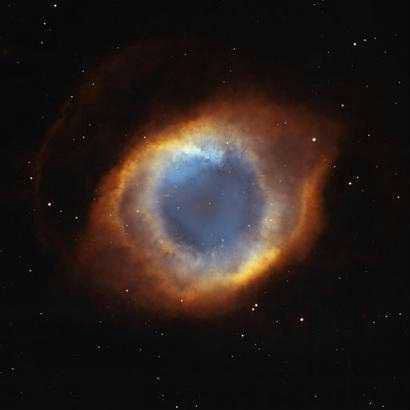
Maybe you've already received this image of the nighttime sky in an e-mail message. If not, take a wild guess at what that eerie looking object in the heavens might be.

Need a hint? Well, according to the originator of the e-mail, this image was captured by NASA. You know the Loud Mouth in the Balcony is skeptical; so I checked it out.

Lo and behold, it was true: NASA is the image's source; I think you'll agree that it's a highly credible source.

Now what do you think the e-mail said that NASA called this image? Take a wild guess.

Uh huh. The Eye of God. Now if we believe that, all we have to do is figure out whether God is winking at us, which explains why we can't see the other eye, or if "He" (pardon my limiting masculine pronoun) is the mythical one-eyed Cyclops. Oh yeah, and where is God hiding the rest of "His" body?

Obviously, the sleuths at snopes.com had wondered the same thing. This is what they dug up:

"This is a real photograph of the Helix Nebula, although it's technically not a single photograph but rather a composite image formed from several photographs taken by NASA's orbiting Hubble Space Telescope and a land-based telescope at the Kitt Peak National Observatory near Tucson, Arizona.

"This image was NASA's "Astronomy Picture of the Day" for 10 May 2003. The tinting of the image is artificial; the Helix Nebula does not naturally appear with the colors shown above. The picture's 'Eye of God' appellation is a title coined by an admirer of the photo due to the nebula's resemblance to a human eye, not something designated by NASA. The nebula is also visible all the time, not merely 'once in 3000 years'."

Of course, the e-mail didn't mention any of these critical details. Instead, it added that un-Christlike Biblical quotation that always accompanies these types of messages:

Jesus said, "If you are ashamed of me, I will be ashamed of you before my Father."

Considering that neither Matthew, Mark or Luke knew Jesus personally, and were writing decades after his crucifixion without the benefit of tape recorders, transcription machines or even shorthand to validate the accuracy of this quote, it seems implausible that it came from the mouth of a man who believed in forgiving 70 times 7.

"Condemn not," he instructed. Threatening others was not part of the Prince of Peace's nature; and it certainly is nothing he instructed anyone else to do. He even told his disciples to wipe the dust from their feet and keep it moving if people didn't accept their teachings. He didn't say, "Badger, belittle, and threaten!" Instead, he wanted them to move on. Those who have ears would hear. Period.

Some folks have glossed over that part of the Gospels, apparently. So they spend their time manipulating others through un-Christlike messages such as this.

It came as absolutely no surprise that the next "photo" in this e-mail was one of a teary-eyed God, peering at Earth, with a face almost as big as the planet itself.

If we are to interpret this photo literally, and if we are to believe that God is human rather than Divine, it would make sense that "He" would be saddened by man's attempt to distort Jesus' beautiful lessons into utter meaninglessness. And, I could see where "He" might be even more disturbed to see that man has made God in his physical image, rather than acknowledging that we were created in the image of God. As described in scripture, that means we are omnipresent Spirit--like God.

Luckily, God is so all-knowing that nothing we do surprises or saddens "Him". "He" knows us better than we know ourselves, and "He" loves and forgives us, despite our shortcomings and short-sightedness.

Now that's the kind of Love that will absolutely bring a tear to your eye, no matter how big your head is.

Sunday, September 25, 2005

For Real, What Is Intelligence?


Conventional wisdom says we must ask the right question to get the right answer. So when I spotted a Chicago Tribune column asking, “If God's so intelligent, why is every last thing on Earth so messed up?” I almost choked on my salt and pepper potato chip. In the article entitled “God’s Imperfect World”, the Trib’s Perspective Editor questioned all kinds of Divine creation—from cats, dogs, and human body parts, to underwater creatures:

“God filled the oceans up with such a creepy collection of unlikely things you would never go to the beach again if you could see some of them gathered in one place. I'm talking bug-eyed fish with teeth like needles and marshmallow-size glow-in-the-dark lures hanging from their noses.”

Chicago Tribune editorial

Quite graphic, huh? Ironically, a few hours later, I stumbled upon an online news report announcing the discovery that crocodiles' immune system kills HIV. By studying the reptiles’ blood, Australian scientists hope to develop powerful drugs to combat the disease in humans. And we thought they were all about the shoes and handbags. Who knew? Even that toothy, bug-eyed fish probably has a powerful healing role to play in life’s theater. In fact, scientists say that only a sponge does not grow or contribute to the evolutionary chain.

It intrigues me that this obviously observant journalist has never noticed the mathematical precision with which everything in the Universe seems to operate. It’s so precise that scientists can measure the distance between planets and the speed a planet rotates, predict when one will cast a shadow over another, and forecast the path of comets.

We debate the creative nature of God vs. Intelligent Design as if they are mutually exclusive. I'll say it again: We must ask the right questions to get the right answers. How about asking, "Why do I think God has a body or acts like a male human? What evidence is there that God lives in a faraway place? Why do I believe that there is imperfection in anything God creates? Is it possible that my vision of God is too myopic?"

And the biggie: "Is it possible that God is Divine Intelligence?" One well-known source describes God as a Being with hands, feet, and other human body parts, then alternately describes God as Spirit. We know that Spirit has no human body. On some pages, God is described as jealous; on others, God is described as love. But we know that love is not jealous. On some pages, God is described as forgiving; on others, "He" is vengeful and punitive.

This is all so confusing, and it forces us to choose which God to believe in: the one who promotes war or prefers peace, the God who reacts with uncontrollable wrath, unspeakable violence, vengeance and sadism when we don't do precisely what "He" wants us to do, or the God who grants free will to all, and allows us to learn from the consequences.

Let's face it, some of us--OK, most of us--learn by doing, not by lecture. Free will and consequences teach us why the rule is golden. Someone can command you to do unto others what you would have them do unto you. But after you discover that whatever you do will be done to you, you will actively choose to treat people the way you'd want to be treated. Is there any question that God is intelligent?

Isn't it fascinating that some of us would rather believe that God is the absence of intelligence (or worse, satanic and tyrannical) than to entertain the notion that ancient scribes who wrote these horrible legends about God were capable of human error? Their vision of an intervening being who answers some prayers, and not others, forces us to believe that God will help someone pass a barber's exam or win a football game, but will not lift a "hand" to shield children about to be attacked by pedophiles or murderers. What's that about?

We're admonished not to ask questions, but the All-Powerful God has nothing to fear from our questions. The All-Knowing God is not threatened by our questions. The Unconditionally Loving God is not outraged by our questions, and certainly not insecure about our search for Truth.

I don't know about you, but it seems more prudent to question our intelligence about God than to question whether God is intelligent. Really.

Friday, September 02, 2005

What’s an Act of God?


The thought of 30,000 unbathed, hungry souls living--barely surviving, really--inside a New Orleans sports stadium with no water, food, electricity, toilets, or air conditioning pales when compared with the conditions on the streets outside. There are reports of corpses on medians and lawns, anarchy and rape. Rape? Did I hear that correctly?

A man's body lies in state in a chaise lounge outside the Superdome; nearby, an elderly woman's body sits in her wheelchair. Babies are dying in their mothers' arms from dehydration and malnutrition, not in Botswana or Rwanda, in these united states of America.

Meteorologists had forecasted Katrina's ferocity; and the people in her path were forewarned. But no one could have anticipated that this horrific hurricane would burrow a hole down to the core of human nature and uncap a geyser of toxic slime that would quickly contaminate an entire city and mesmerize a nation flooded with perhaps too much eyewitness news.

On my sorority's local graduate chapter listserv, hundreds of us were riveted by the story of the tense search for two of our members who were vacationing in New Orleans when Katrina barged in. Finally, word came from the daughter of one (and the granddaughter of the other) that they had been contacted and were safe inside their downtown hotel. We breathed a collective sigh of relief. A couple of days later we learned that they had arrived in Texas by bus. They were lucky.

It seems that another bus had been sent to transport the hotel guests out of town, but it was hijacked, looted, and the driver was killed. The second driver assigned to the rescue crept through the darkness with his headlights off. And the lights remained that way until the bus and its precious passengers were safely out of harm's way in the lawless city with snipers taking aim at innocent passersby and choppers delivering food. Can you imagine being safer driving with your headlights off? With no streetlights? Absolutely chilling.

I had my own problems. I wasn't sure how to find my aunt, who has lived in New Orleans most of her adult life. I tracked down her daughter in Atlanta, and was relieved to discover that she had insisted that Aunt Georgie and her caregiver drive to Atlanta. They arrived the day before the storm hit. It was good to hear Aunt Georgie's voice.

"We don't understand why God lets these things happen," she said wistfully, and a bit confused. "We just have to accept it."

My dear aunt, once a college instructor and now suffering from dementia, doesn't quite grasp the gravity of the conditions back home. She told me that she's returning home in a few days. Heaven only knows what she'd find, if that were possible.

I read a newspaper story about a woman who returned to her heavily damaged New Orleans home. Pointing at the crucifix on the wall, she despondently told the reporter, "That was supposed to protect my home. I guess He let me down."

Is that what God does--let us down? Really? I'll bet that even folks who believe that God would forsake us for any reason and would blithely harm our bodies and destroy our possessions must be crying, "Why us, Lord? What did we do to deserve this devastation?"

Some say God sent Katrina to punish America for something or another; but no one has said specifically why Bible Belt states such as Louisiana, Mississippi, and Alabama were selected as sacrificial lambs. Most who live there believe that God punishes the innocent to show the rest of us the power of His wrath. It's a warning, they say, an opportunity for us to change our behavior.

Of course, this presumes that God is not Love, although most of us don't realize it. That's because most of us have never asked the simple question, "Would Love do that?"

We're admonished to have faith and not ask questions about God. We cannot possibly comprehend what God is or why God does anything, they say. OK. So let's not question God. Let's question ourselves, instead:

  • If five foreigners kill thousands of American office workers because the U.S. government supports the men's enemies, you would call it _________.
  • If a nation's leader tortures his people because they disagree with him, you would call him _________________.
  • If your boss says, "Do as I say, not as I do!" you would consider her ___________.
  • If a parent locks a child in a basement without food or water for a month because she stole candy from the corner store, you would declare that the parent is _________.
  • If one person is blamed or punished for the crime of another, you would declare it an ____________.
  • If a parent leaves his or her helpless newborns in the care and control of someone known to be satanic, you would label it _______________.
  • If a father of ten takes his kids to a foreign land and gives only two of them enough money and information to get back home, you would say he was ____________.


Take a moment to review your answers. How many times did you fill in the blank with the word "mysterious"? I ask that because many of us fervently believe that God has done all of these things--and more. Ironically, when God performs these deeds, we no longer see them as terrorism, genocide or child abuse; we say, "God's ways are mysterious."

Isn't it "mysterious" that we never give God the benefit of the doubt? Isn't it mysterious that we automatically believe the horrible things we've been told about God, and we never say, "Wait a minute--would Unconditional Love do that?" Isn't it "mysterious" that we only find these acts to be unjust, sadistic, and hateful when humans do them?

If we believe that God is unfair, judgmental, and unforgiving, are we more (or less) likely to be unfair, judgmental, and unforgiving? If we believe that God is violent and vindictive, are we more (or less) likely to be violent and vindictive? If we believe that God has no regard for our well being, are we more (or less) likely to come together or fall apart when tragedy strikes?

Our ancient ancestors didn't understand the occasionally destructive force of nature. Lacking the benefit of scientific instruments to explain conditions that precipitate storm patterns and hurricane seasons, they concluded that they must have done something to elicit the outrage an awesome and volatile force who lived in the sky; they were being severely punished. We are no longer these ancient people. Why are we clinging to these ancient thoughts in 2005 C.E.?

What if we decided to believe--I mean truly believe--that God is good all the time? What if we looked at everything that happens through that prism? Instead of falsely accusing the omnipresent God of forsaking us, we might see that it was the omniscient God that gave us the reasoning faculties to decide whether to live in areas that have "hurricane seasons". We'd also see that it was the omnipotent God that provided the technology to predict a hurricane's arrival so that we can get out of its path, in the event we decided to live in or visit these areas.

Are God's ways "mysterious", or are our beliefs about God the real mystery here?

Our beliefs are the authors of all our life dramas. Our beliefs script our perceptions--and our responses to every situation we encounter. Our beliefs dictate how we treat each other, how we perceive ourselves, how we move through the world of work. Our beliefs impact all of our outcomes. Our beliefs create our reality. It's possible that some of our beliefs need to be questioned, maybe even forsaken.

When we look at New Orleans, we see that the human tragedy dramatically upstages the natural one. It is no mystery that anarchy is boldly strutting down the path cut by the uncontrollable force of nature we call Katrina. In fact, the only mystery is why we believe it was an act of the Unconditional Love we call God.

One day, we might decide to leave this drama behind.

Tuesday, August 16, 2005

Bravo! What a Brilliant Performance!


One Sunday afternoon last winter, I walked out of a movie theater so overwhelmed by Hotel Rwanda's larger than life inhumanity that I dared not get into a cab. I was thoroughly convinced that my emotional energy could not fit inside an automobile. Instead, I walked the mile home so that the Chicago “hawk” could snatch my grief, shake it into tiny harmless packets, and lift each one skyward.

Perhaps they showered me as pure joy months later, as I left the inspiring funeral service of Ebony magazine founder, John H. Johnson. The regal service celebrated the grandson of former slaves, who was born into the inhumanity of the Jim Crow South, and whose destiny was pre-determined. To ensure that black children in Arkansas City, Arkansas received no more than an eighth grade education, there was no high school in town. Like everyone else, Johnson was expected to toil in the cotton fields for the rest of his life.

As President Bill Clinton remarked during one of the service’s frequent moments of levity, “Rural Arkansas City has only one road in—and one road out. No one ever goes there by accident; no one ever leaves by accident.” So we can imagine that it was with great intention that 15-year old John and his mother, Gertrude, took the only road out of Arkansas City in 1933 and joined the Great Migration north, where a black boy was allowed to attend high school.

Perhaps by example or genetics, his widowed mother’s bold determination to live outside the limitations of racial bigotry emerged within Johnson. He nurtured this innate ability to see far beyond the footlights of America’s apartheid theater, moving in faith, knowing no fear, overcoming barriers faced by no American publisher before him, and earning the designation as the greatest among them. And that is how he is remembered.


One after another, some of the nation’s best-known political, business, and religious leaders’ tributes honored this humble man who ignored the appearance of obstacles, and persisted through any that managed to grab his attention. They told classic stories of his tenacity.

"Failure is a word I don't accept."

When automakers refused to advertise in Ebony, for example, Johnson sent a salesman to Detroit every week for more than two years, until a signed contract materialized. When he wasn't allowed to buy a parcel of land in downtown Chicago because of his race, he hired a white attorney who bought it in a land trust. Then he built the first Black-owned downtown office building. Failure is a word Johnson didn't accept.

It was Johnson who lifted the curtain of racism and exposed untold numbers of successful professionals in the Black community who had been declared non-existent by major media. He documented them in words and pictures, and empowered black girls and boys who grew up with Ebony and Jet magazines on their living room cocktail tables to see greater possibilities for themselves. Johnson then financed these young people's dreams with his dollars, funding the civil rights movement to open doors for them, and donating millions to college scholarship programs so that they could open doors for themselves.

From the welfare rolls as a child, Johnson became one of the wealthiest men in America and the recipient of the nation's highest civilian honor, the Presidential Medal of Freedom. Formerly denied a high school education, he later held more than 30 honorary doctorates from universities throughout the country, including Harvard, where he served on the advisory board of its prestigious business school. In 2003, Howard University named its communications school in his honor.

At his funeral, famous men recalled him as a tenacious salesman, no-nonsense businessman, tireless executive, task master, humorist, philanthropist, visionary, loyal friend, mentor, and loving family man. No one called John Johnson a prolific metaphysician; but clearly, he was every bit of that. He understood the creative power of thought. He masterfully manifested things from the invisible and the seemingly impossible. He single-handedly made black consumers visible to corporations that consistently had denied or ignored the buying power of the black community. He practiced Divine right action, even though he might not have called it that. He was a healer of social ills. And John H. Johnson certainly created a life of abundance for himself and countless others whom he inspired or employed.

What we have witnessed is an incomparable performance, dramatically executed by a powerful soul, an indisputable metaphysician. As befits the end of such a spectacular act, the Curtain of Life gracefully lowered, and gratefully paused in deference to a human who understood divine potential—and fulfilled it.

Thank you, John H. Johnson, for being.

Saturday, July 30, 2005

Truth Is Still Stranger than Fiction


This article first appeared in the August 2005 issue of Sharing the Joy newsletter, published by The Joy Cathedral, Seattle WA. www.thejoycathedral.org


I saw the funniest commercial the other day. It was a spot for DiGiorno frozen pizza. The scene: Geppetto’s cobbler shop. He’s scolding Pinocchio. Again.

“You’ll never be a real boy if you don’t stop telling lies!” he admonishes his son, who presents his Dad with a piping hot slice of pizza.

“Delicious!” Geppetto raves. “What pizzeria did it come from?”

Instead of saying he popped a frozen pizza in the oven, Pinocchio lied. (He wouldn’t be Pinocchio if he hadn’t, right?) And he didn’t stop, even as his nose jettisoned halfway across the room. Panicked that he’d been caught in another tale, Pinocchio’s head jerked one way, then another, his nose knocking everything in its path onto the floor. I howled!

I was still grinning when we returned to regular programming, remembering why this allegory was one of my favorite childhood stories. After 125-years, Pinocchio endures because it teaches cause and effect so powerfully: everything we do has a consequence.

Suddenly the thought occurred to me: What if a 21st century editor collected a bunch of wonderful stories that teach valuable life lessons, like Pinocchio, and published them in one volume? Two thousand years from now, would there be people who regarded this powerful book of wisdom as inerrant history? Would the Creationist theory be that humans evolved from wood, becoming flesh after they began to tell the truth and perform good deeds? Would non-believers be threatened that they will be “left behind” on planet Earth, where they’ll be planks in woodpiles higher than Mount Everest and set afire?

For believers, will the idea of being eternally human, rather than woefully wooden, make them feel so superior, so much closer to their God that they won’t value the lives and rights of those who don’t share their beliefs? Will they feel that they have Divine Right to dictate where and how others should live and whom they should love? Will they violently punish others, mirroring the modus operandi of their wrath-filled Creator?

Let’s all bow our heads in solemn reverence to truth that is still stranger than fiction. And while
we’re in that space, let’s ask ourselves: Is the value of powerful stories such as Collodi’s Pinocchio found in their life lessons or in their literal details?

Shall we teach our kids that their noses will grow longer than their arms if they don’t tell the truth? Or is our message that poor choices produce poor results? Do we tell them “an eye for an eye” means that they should respond to violence with violence? Or do we tell them to choose their thoughts, actions and reactions wisely because whatever they send out will ricochet back?

Unconditional Love has given us the freedom to make these decisions—and to learn the lessons that result from every choice. That Truth supersedes all man-made fiction.

Monday, July 04, 2005

Life is ALWAYS Fair


I'm an armchair computer geek, have been since I bought my first computer (a Commodore Vic 20) in the early 80s. I was one of AOL's first customers. In fact, I was online before you could charge down a entry ramp to the Information Superhighway unescorted; I used Prodigy as a gateway. "Blogging" is the latest online phenomenon to grab my attention. I'm utterly intrigued by the fact that anyone with something to say--a kid or a corporate CEO--can speak to the world, and the world can speak back. How cool is that?

I knew I had to do my homework, if I was going to do this blogging thing; so I dropped in on one of my favorite sites, Beliefnet.com, where a number of blogs, both conservative and liberal (as in generous?), reside. One blog called out to me: it was Swami Uptown's. I snickered. Was he related to the hilarious metaphysical comedian Swami Beyondananda? I couldn't wait to experience this Swami's wisdom.

Swami Uptown's June 27, 2005 post ("Size Counts--But We're Not Talking About Brains, Are We?") reflected on the un-Christlike behavior of the Christians who created the war in Iraq. This was not a blue-blood intellectual rant against the unenlightened souls who produced the mind-numbing, interminable war epic. Swami Uptown (brainiac journalist and author Jesse Kornbluth) wanted to know what's up with the rest of us:


"I have been saying for more than a year--to my great surprise, I seem to be the only one saying it consistently on Beliefnet--that the spiritual world is, like the real one, a small, closed system. The hatred you aim at me will, if it misses me, zing around the world and hit you in the back of the head. The depleted uranium we use in weapons overseas is blown by dust storms to our shores. The terrorist we do not convert with our goodness learns from our duplicity that it is good and just to strap explosives to himself and kill our children.

"It's the Golden Rule, just flipped. Jesus warned about this. It's at the heart of the Buddha's teachings. Really, it's central to all important religions: Do unto others...because what goes around, comes around."


As they say, and as the good Swami so eloquently illustrated, common sense ain't very common. We know about the Golden Rule; we've heard "what goes around, comes around" a bazillion times; still we don't believe it. If we did, we'd always treat others the way we'd want to be treated. Always.

Kornbluth--er, the Swami--postulates that we're looking for proof. After all, we don't always see folks getting what they deserve. (Where have you read that before?):


"Think of the truly awful people you have known who died, rich and successful, in their own beds. [However], more often than not, we see at least a flash of that law called karma."


Ah yes, the "k" word. We learned all about that in Drama Queens, too, didn't we? But, wait a minute. Did the Swami just say "more often than not"? Does he mean that folks can somehow elude the Universe's natural balancing act? If so, methinks the Swami wrapped his turban too tightly.

As we know, karma is the natural consequence of an act. It's the immutable "whatever you do comes back to you" law of the Universe. It operates whether we "see" it or not. And, oh my goodness, don't we like to "see" our villains get what's coming to them by the time the credits roll? We might even want to write and star in those scenes ourselves.

We voluntarily entangle ourselves in their drama (and their karma), instead of turning our cheeks and the rest of our body costumes in another direction, exiting the stage, confident that the immutable Law of Karma will write a more powerful ending to the painful scene than our meager brains could ever compose.

Part of the intoxication of Earth's drama is that when we're on its stage, we're so "in character" that we believe that we are our body costumes, rather than mirror images of the omnipresent spirit known as God. So we expect to see consequences crash down on bad actors by the time they leave the Earth stage. When that doesn't happen, we dismiss the Law as bogus, and conclude that Life is unfair. Arrrgh! It can even confound those who are more enlightened.

Kornbluth, for example, observed that the folks who brought us this war of Biblical proportions proclaim their love and devotion for a God who smites. (They should, he says, because they created that God in their image). On the other hand, by claiming that karmic law isn't consistent, Kornbluth seemed to forget in whose image they (and we) were created.

If we were made in God's image, instead of the other way around, that means that war architects and supporters who kill in volume, as well as more pedestrian murderers, thieves, spouse and child abusers, rapists, spammers, phishers, and other con-artists, computer virus creators, adulterers, and all who intentionally harm others are just as eternal as God is. Their "live-by-the-sword-die-by-the-sword" comeuppance might greet them in their current roles. Then again, it might not.

But before we conclude that karma is hit or miss, let's not forget that time is a manmade construct. In Spirit, there is no such thing; so it's never too late to repay a karmic debt. You can run out the clock by leaving your body, but you can't leave your soul, and you can't escape the long arm of Universal Law.

With all due respect to the dear Swami, I think the folks in the Bush Administration should be admired for their bravery. Instead of us squirming in the seats of this educational theater, waiting for the curtain to fall mercifully on this poorly planned and executed script, I think we should be on our feet, wildly applauding.

What a spectacular, karma-winning performance they've given! What a mind-boggling personal sacrifice each of them is making so that millions throughout the world can learn that violence begets violence. What a dramatic demonstration that whatever you do really does come back to you.

We should be grateful for the powerful lessons we're learning from the audience. Surely, we wouldn't want to be on stage with them. Would you want the karmic debt these guys are amassing each day as the body count rises, the poor get poorer, and the environment becomes more endangered? Better they than the rest of us, I say.

Bottom line, loved ones: All is well. We outlive our dramatic roles on planet Earth, but we don't outlive Eternal Law. Due to the Law's natural ricochet effect, Life is, was, and always will be fair. That's the first No-Drama principle. Number two: because Spirit is omnipresent, God is never far. Third, death of the body is not THE END of a soul's life. And finally, absolutely nothing is unforgivable.

A God who is Unconditional Love would have created this world no other way. That's my story, and I'm stickin' to it.